Wednesday, 20 May 2009

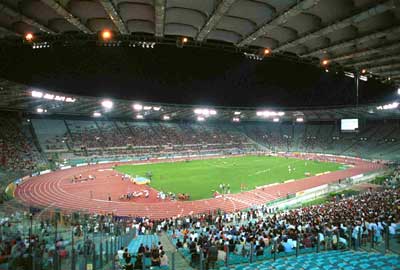
Rome Champions League Final - next Wednesday

Champions League final better than a World Cup final?

Only one week we still have to wait before watching the massive Champions League Final from the Eternal City of Rome. The old and same time the new England champion Manchester United will face FC Barcelona, another continent's domestic league winner on Stadio Olimpico, next Wednesday, 27 of May from 19:45 GMT in what experts anticipate it would be one of the greatest finals of all time. The great clash will be live in Britain on Sky Sports 1.
At the end of the game we will see whether Manchester United will become the first team to
defend its cup won a year ago or would be a fantastic season for Barcelona by achieving its third Champions League trophy alongside with the Spanish League and Copa del Rey (Spanish Cup).

Most of football fans believe that this is the right final due to the excellent shape of both teams in 2008-2009 season. The final stage is the best way we can argue which team is the best. It is also the world's best players duel: the present Ballon d'Or winner Cristiano Ronaldo or a possible future one, the little Argentine Leo Messi.

Both squads have won the leagues in their countries. Manchester United have won it mathematically last Saturday on Old Traford against the rivals from Arsenal after a 0-0 game. Barcelona have assured their Liga after humiliating on Bernabeu the all time rivals Real Madrid with an incredible 6-2.

Let's rememorate how the next week's finalists got through the rounds in their way to Rome.

Manchester United

At the biginning of winter the Red Devils got the first place of Group E with only one point more than Villareal, a team which caused to them problems, holding up the CL winners in two consecutive draws. In the next stage, a 0-0 on San Siro and a secure 2-0 win back at Old Traford against Italian champions Internationale got them to the quarter finals. Surpringly, FC Porto was tougher to knock out than Inter. Man UTD drew 2-2 at Old Traford and weren't so sure that will get to semis. But a superb 35 meters shot from Ronaldo's right foot saved the Red Devils and it assured a spot in the semi-final against Arsenal. The two leg semi-final with the Londoneer side was apparently a much easier task for Manchester UTD than it was in the previous stage. They won 1-0 at Old Traford by John O'Shea's header and 3-1 at Emirates, with Ji-Sung Park, and Cristiano Ronaldo two times scoring. Robert Van Pesie scored the only goal of Arsenal in both games.


Barcelona

The 'blau-grana' side won easily their Group C, scoring 18 goals against teams like Sporting Lisbon, FC Basel or the fresh Uefa Cup winners Shakthar Donetsk. In the first knockout stage they eliminated the champions of France Lyon. With a draw in the first leg and a comfortable 5-2 win at New Camp, Barcelona progressed to the quarters. Another easy pass and again against some other champions, Bayern Munich. Barcelona scored four goals in the first game in Catalunia conceiding none and drew at the Munich stadium, in the second leg. But way harder it was when the catalan squad faced Chelsea in semis. Despite attacking Petr Czech's goal almost all the time, Barcelona did not succeed to score in the first leg. The game from Stamford Bridge was simply thrilling, a drama which it was won in the last minute by Barcelona. Essien opened the score for Chelsea in the ninth minute with one of the best Champions League goals ever. Chelsea made a good defensive game in both halfs, but luckly for Barcelona, Andres Iniesta scored in stoppage time and put Barça into the final.


Too many young people die on Kent's roads

Kent Fire and Rescue Service (KFRS) now attends 25% more road crashes than house fires. In the last three years over 500 young people have been killed or seriously injured on Kents roads. As well as being at risk themselves, young drivers pose a significant danger to others.
One in three young male drivers will write off the car in their first year of
driving. The most likely killer of teenage girls is teenage boys driving.
KFRS promotes now Operation Carmageddon, a campaign that aims to wake up youngsters' attention in order to drive more carefully. Ambulance drivers and firemen will be touring all over Kent and will explain to students why they must drive with caution, what are the risks and how to deal with them.

Internet and newspapers in the eyes of a sixty-year-old


In this article published symbolically on the web we try to find out if and how the elderly people are using the Internet. Also we want to know their view in respect of today’s newspapers.

In these times when the Internet is perceived as an indispensable tool without which the modern world we live in can not run, to what extent the written press is considered the main and the most credible source of information? In the era of speed and breaking news, the life of written press becomes day after day harder.

It is obvious that youngsters use to a small extent daily newspapers as a source of information and of course the Internet gives the amount that they need, but how the situation is when it comes about people who are not so young? We will see how this looks through the eyes of a sixty-year-old man.

David Bridgeton is a landlord from Folkstone who is letting houses for students in Canterbury. He is in the market for more than 20 years and he considers him self as having one of the best prices and services designed for the students needs.
"I was 40 years old when I took the business. I took it from my father so we have an experience of over 60 years in this field” David Bridgeton said.

For Mr. Bridgeton the Internet represents a way by which the family business becomes easier.
"I can say that for me the Internet is a useful invention, even if some people have a negative opinion about it. I joined a few websites of accommodation for students. From the Internet comes a large part of young people who I rent houses for. Only for the university year 2008-2009 we have 68 houses rented by students that I got in touch with through these websites ", the landlord says.

It is obvious that Mr. Bridgeton is taking advantage of the Internet in the most efficient way possible. But is this the only reason why he sees the Internet so useful? David Bridgeton clarifies us in respect of the above question:
“My two children are living in America for fifteen years so the e-mail and the instant messaging software keep me in touch with them. They provide quality services; they are fast, easy and cheap. You only pay the monthly internet fee”.

In the end of our discussion, David Bridgeton shared some thoughts regarding the way how he stays up to date with the daily events:
"I can say that I prefer newspapers instead of online journalism. From this point of view still I am a classic. I love to read quality publications such as The Times or The Independent. I have some favorite politics analysts and I love to read their comments. I know that I can do this online, but I like to go to buy the newspapers that I read. In this way I meet old friends and together we share thoughts upon events that press covers”.

How is life for overseas students at Christ Church Uni?

The video bellow presents the circumstances in which the international students live in Britain generally, and how is the life of three Nepalese youngsters in particular. They crossed the world from the Himalayan country to in Canterbury to make their way in life. The Nepalese students talk about their studies, their life in Canterbury and how they are treated by the locals.

Canterbury plays for Britain


Having one of the most numerous young populations in the UK, with over 30,000 students, Canterbury could be the place that will produce some stars for the London Olympics 2012, especially for the tennis tournament.

Since Britain’s new tennis talent Andy Murray came to the scene, the “white sport” in this country entered in a new era. Maybe sooner than everybody thinks we will see the first British winner at Wimbledon in the last seventy years. Now youngsters from all over the country want to be like Andy Murray, the kid who has learned tennis in the highlands of Scotland.

Taking part in this “tennis revolution”, Canterbury has one of the best tennis clubs in the South East, where many kids are learning the secrets of this sport, hoping that one day they will reach the top of the ATP rankings. John Gotke is the coach of Canterbury Lawn Tennis and his main job is to discover and prepare young tennis players in all over Kent to win Grand Slam events and-why not: the Davis Cup. He said:

“I am here to teach tennis for everyone who wants to, but my main job is to find young talents who could represent the next generation of this sport”.

Canterbury Lawn Tennis has a modern infrastructure with six floot-lit astro courts, two grass courts and a brand new indoor centre. In July 2006 the three-court indoor centre was officially opened.

The tennis centre is a part of Polo Farm Sports Club. Besides tennis teams, there are hockey clubs (men, women and junior), football, lacrosse, cricket and croquet. Polofarm is also the venue of several sports teams of Christ Church University: hockey, lacrosse and tennis. In order to sustain the youngsters who play tennis, Canterbury Tennis Club is the home of a junior open tournament that takes place every year, at the beginning of August. This year’s open has taken place between 4-8 Augusts. This is a LTA Grade 4 tournament and it is an event of East Kent Tour 2008.

The club has its origins back in 1948, when a bunch of people created a place where they could spend their spare time doing what they like, to play tennis. Now there are more then 20 teams: men’s, women’s, mixed, vets, juniors. These teams that have about 200 senior and 80 junior members are competing in the Kent, East Kent and Dover leagues.

This is a club like many others in the UK that one day perhaps will put forward some great names for the British tennis, possibly even greater than our day’s champions Tim Henman and Andy Murray.


EMS blames E-ON for its black times

The following post is an article that I have written in 'Gazeta de Bacau' newspaper and it was published as the main story of the issue of March 28 2008. 'Gazeta' is a weekly newspaper in Bacau, the East Romanian town where I was born. It was my second job at a local newspaper and I worked there for more than a year, before coming to Canterbury.

The story is very important because it covered an important issue of the people from Bacau at that time. Mainly, the region's power suplier, the German energy giant
E-ON was accused by the state owned company 'Electrical Maitenance Services' Moldova (EMS) of unlawful practices and sabbotage regarding the network's maitenace contracts. Losing more and more maitenance contracts, EMS's financial statements predicted an eventual bankrupcy.

City residents were suffering because of this 'war' between the energy suplier and the maitenance services provider. Lots of problems regarding the electric power emerged in the city. Even the wires got frozen several times in winter time, leaving people without power. EMS could not intervene due to the ending of contracts impossed by E-ON.

Bellow is an aproximate translation into English. I hope it is pretty clear and I wish you a nice lecture:


The energy distributor E-ON was heavily accused of sabotaging the activity of “Electrical Maintenance Services” Moldova (EMS)

All this happened Wednesday, March 26, in the conference room of a hotel from Piatra Neamt. Apparently, the reason EMS’s director Toma Suru called the local press for is to announce the job cuts plan that will affect the company. Mr. Suru, the chief of EMS’s Moldova branch began by explaining why the central executives are missing from this meeting:

"Today should also be here the general director, but he had to stay in Bucharest to manage some organizational activities about the NATO summit that will take place in less than a week”.

A brief history of EMS


Electrical Maintenance Services it is a public funded company that was established by a governmental resolution in 2001. At that time this action was a necessity due to the partial privatization of the public energy supplier.


Until 2001 only the public company held the energy distribution and also the maintenance services for the entire national network. In 2005, the E-ON energy giant took the responsibility of supplying electricity for Moldova and the rest of Eastern Romania. This means that the main customer of EMS it is the massive German company, because obviously the electrical network needs to be maintained and repaired.


E-ON seems to be the main problem of EMS


TomaSuru thinks that from 2005, since when E-ON Energy operates in Moldova, lots of problems emerged.

"In 2005 E-ON has limited the contracts which we had prior to the privatization of energy, even if our company has an experience of 120 years”, TomaSuru says. He added that market liberalization allowed the access for small companies with few staff and poor experienced, but evidently companies who demand low prices:


“It looks like E-ON prefers low prices instead of quality services. For this reason we are about to be excluded from the market, although at national level we have 11,000 workers, of which 1400 in Moldova. Things like professionalism and infrastructure are on our side, but the E-ON leadership does not think that this is enough to give us contracts and so to do the work for which we are entitled to”.

EMS was forced to drop prices in orderto compete against those tiny firms. Also, they had no option than to accept one-sided contracts imposed by E-ON. According to the press release, the EMS central administration says: "... in spite of negotiations, E-ON Moldova has not fulfilled the obligations assumed, invoking the lack of liquidity and lack of materials. In 2007, E-ON issued the orders for only 50% of the contracts awarded. As a consequence, the EMS’s revenue has seriously diminished”.They are also accusing E-ON of unfair practices as stealing their skilled personnel.

An analysis on the financial results for the past two years reveals that the company is no longer cost-effective.


35% of employees will be dismissed


The lack of contracts convinced the leadership of EMS to prepare a staff restructuration plan. This will be applied to all over the eight branches of the company. Moldova division will waive 35% of 1,400 employees, in three stages. The first one means that the employment contracts will go to an end by mutual agreement and the deadline of it is April 11. The last two stages involve the elder aged workers with health problems.


"However, we really do not want to get to the third phase. We will use it only if the outlook will be bleak indeed”, Mr. Suru said.

Workers to be sent home will receive compensatory wages (between 2-20 average national wages) depending on seniority, training and other such criteria.

Britain’s future safeguarded by humanitarian organizations

A proverb says that young people represent the future of a country. Whether this future will be good or bad depends mainly on the government’s reforms regarding the welfare of youngsters.
If we check the figures, a presumption could be made about the Britain’s expectations. The 2001 census shows that in the UK live about twelve million people aged under sixteen which means that today’s adolescents will be in a couple of decades the leading generation.

But what about the children who are living on the streets? How did they end to be alone, without any help from those who are supposed to watch the well being of youngsters? Until the central administration of the country finds the answer, humanitarian associations work for the education of street children.

A recent report from the National Statistics shows that 60,300 children were looked after at 31 March 2006. Lately, the increasingly number of social services departments (SSDs) contributed to the drop off the education problems of the children that were looked after. This fact is very important because the education level of youngsters could tell us what the prospects are about the future of the country. The Government’s efforts should be focused on investments in the education system and also in children with special needs, even if the financial crisis is now considered the number one issue that has to be solved.

A National Children's Bureau study reveals the contribution of social services to support vulnerable children in school. This involvement is not limited only to children looked after by the local authority, but to a wider group of children in need. In this initiative were implicated families and they valued the mediating role and support that professionals adopt in the social work that is provided. Researchers conclude that the good job of the last years about the education of children in need lies in the partnership between SSDs and the Department for Children, Schools and Families (DCSF). The research was made during 1997/1998 and is based on questionnaire responses from SSDs in England and Wales.

Integrated Service Programme (ISP)

One of the best examples of organizations that help children that have issues it is the Integrated Service Programme (ISP).
This provider of childcare was formed by a group of foster carers back in 1987. They have specialist teams in education, therapy and social work. The goal of the ISP is to integrate children to whom life was not so friendly into society. On its website it is briefly stated the association’s target: “We care for "difficult to place" children and young people, whose development has been impaired by abuse or trauma, resulting in emotional, behavioral and social difficulties”.A multi-disciplinary approach enables them to create an individual care plan for each child, focusing on their complex needs.

The association is currently working with approximately fifty local authorities and caring for over 160 children and young people. An educational team monitors and co-ordinates the education of all children and young people placed with them. To do this effectively, the team continually gets in touch with the child or young person's mainstream school or college. In addition, ISP has created its own fully inspected schools for those children and young people who find it particularly difficult to access a conventional school environment.

Presently, 85% of ISP children attend local normal schools. ISP educates the remaining 15%. The foundation’s activity takes place mainly in South East England. There are 6 centres located in Kent (Rainham, Teynham and Whitstable), Buckinghamshire, North London and Sussex. The Central Office is based in Sittingbourne, Kent. A recent inspection report (2007) made by OFSTED (Office for Standards in Education, Children's Services and Skills)shows thatthe ISP Special School in Sittingbourne is prepared from all points of view to teach children with needs.

In 2006 an interesting report about children that are under the wings of ISP was released. Basically, the study shows the manner in which the youngsters progressed in respect of 4 major outcomes: health, safety, school results and entertainment. To the question “Are you a regular cigarette smoker?” 84% said no. Regarding the drug use, just 4% of the respondents said that they are consumers. The same situation is if we talk about the harmful use of alcohol. Only 4% of them drink alcohol. The children were asked if they were victims of discrimination. 93% answered “no” to this question. Regarding the education, 92% of ISP young people were regularly attending school or college. In terms of school results, 75% of the respondents who entered in examinations gained 5 GCSE’s, A – G Grade.

Lee Wright, an education manager who works for ISP for seven years told us that now they take care of 194 children. He is a member of an education team that works for the ISP Centre in Watford. “I’m working for the ISP from 2001and my role is to help that children that are in our care to be ready for school. That means that if we have a child who was abused, who had or still has some social and behaving problems and is not ready to start the school, we help him. We teach these children what they must know in order to attend again the school, if it was interrupted by his issues”, says Lee Wright. Regarding the financial sources which help ISP to accomplish its mission, he explained that the money come from the government, through social services. Mr. Wright told us a story about his first child that he helped. “The first child that I helped in the Watford I.S.P centre, seven years ago was Lewis, a 14 year old boy from North London. He had a gap in his education of about two years due to his family background. I can say that he was eager to learn the basics. I taught him Mathematics, English Language and Literature for three months. Over this period of time he learnt almost two years of educational knowledge that he had previously missed. He is now attending the university, he is doing well and I’m very proud of him”,Lee Wright remembers.

The good work that is made by this kind of organizations for the wellbeing of young people entitles us to look forward with hope about the future of the country.